News
Meridiam-Led Aqaba-Amman Water Desalination and Conveyance Project Breaks Ground
18.11.2026
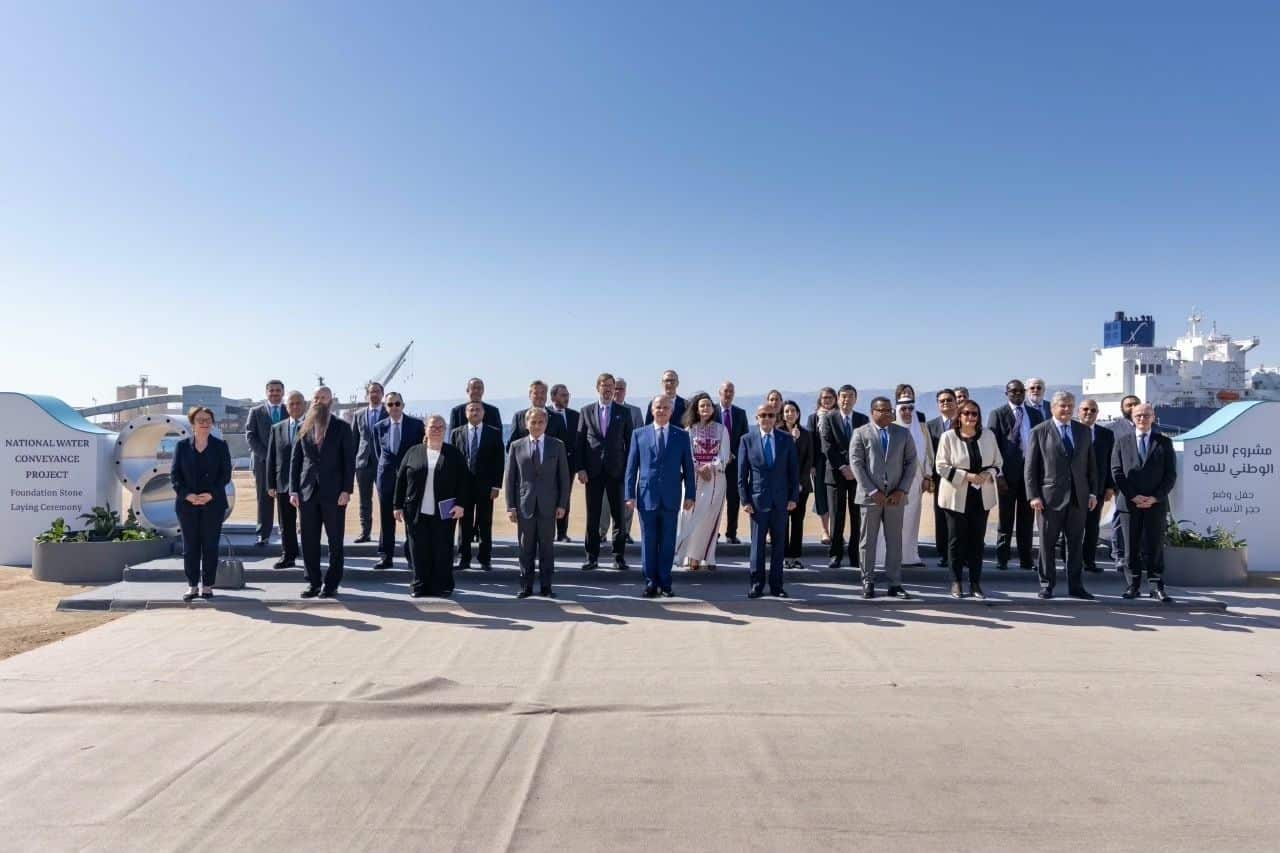
A major milestone for the Aqaba-Amman Water Desalination and Conveyance Project was marked on 18 November 2026 with its groundbreaking ceremony in Aqaba, under the patronage of Prince Faisal bin al-Hussein of Jordan, and in the presence of Raed Abu al-Soud, Jordan Minister of Water and Irrigation, Nicolas Forissier the French Minister Delegate for Foreign Trade and Investment Attractiveness, Franck Gellet the French Ambassador to Jordan, and Thierry Déau, Founder and CEO of Meridiam.
The groundbreaking marks the start of construction of this critical infrastructure project, a national priority for Jordan that will significantly strengthen the country’s long-term water security and help address its chronic water deficit. Jordan is one of the most water-stressed countries in the world, where most households currently having access to water for less than two consecutive days per week.
Thierry Déau, Founder and CEO of Meridiam, said: “The Aqaba-Amman project is much more than a major infrastructure project. It addresses one of the most fundamental needs of the Jordanian people: reliable access to water. This is what infrastructure is ultimately about: anticipating critical needs and delivering lasting impact for people, communities and the environment. We are proud to contribute our long-term vision and expertise, alongside our partners, to making such a complex and essential project a reality.”
Structured as a 30-year Public-Private Partnership, the Meridiam-led project includes global and regional partners SUEZ, VINCI Construction Grands Projets, Jordan Social Security Investment Fund (SSIF) and Orascom Construction, and represents a total investment of USD 6.7 billion. At its heart, will be one of the world’s largest desalination plants, designed to deliver over 300 million cubic metres of drinking water annually, equivalent to around 330 Olympic-size swimming pools every day. Upon completion in 2030, the project is expected to provide an additional 110 litres of potable water per person per day. By 2030-2040, it is expected to serve approximately 40% of Jordan’s population needs.
The project will also include approximately 418 km of pipelines, creating a major water corridor across Jordan to transport desalinated water from Aqaba on the Red Sea to Amman.
Finally, a significant share of the project’s energy needs[1] will be met by renewable power, supported by a 280 MW Solar power plant, the largest in Jordan spanning an area equivalent to around 700 football pitches.
Beyond strengthening Jordan’s water security, the project will deliver significant environmental and social benefits. Together, these features are expected to reduce carbon emissions by at least 6.7 million tonnes over the concession period, while providing a potential model for the decarbonisation of large-scale water supply infrastructure. The global project is also expected to create more than 33,000 jobs during construction and 2,600 during operations.
The project benefits from the support of a broad coalition of leading international development finance institutions and climate-focused investors, underscoring its strategic importance for Jordan and the international community. Its financing structure combines equity from the project sponsors, international and local currency financing, as well as grant funding, reflecting the scale and long-term nature of the project. The project notably benefits from significant support from the Green Climate Fund (GCF), of which Meridiam is an Accredited Entity, further reflecting the project’s strong climate dimension.
Source: [1] About 80% of the desalination plant’s energy needs
Related News
18.11.2026
Meridiam-Led Aqaba-Amman Water Desalination and Conveyance Project Breaks Ground
29.10.2026
Meridiam Celebrates 10th Anniversary of Northeast Anthony Henday Drive alongside the Government of Alberta through Alberta Transportation and Economic Corridors